The AI CFO is not a chatbot—it is a live data layer

Category: AI CFO
The difference between applying generic AI wrappers to accounting software and building a proprietary, agentic operating model.
Quick Look
- The Wrapper Trap: Adding a conversational AI interface on top of messy QuickBooks data does not create a CFO; it creates a faster way to read bad math.
- The Data Layer: A true AI-native finance function requires a unified company brain where cap tables, operating metrics, and live ledgers talk to each other without manual reconciliation.
- Predictive, not Historical: Traditional accounting tells you how much cash you burned last month. An agentic financial model tells you how a 10% drop in next quarter’s conversion rate will impact your Series A timeline.
In this article
- The Commoditization of the Dashboard
- Breaking the Silos: Cap Table vs. Cash Flow
- Why Generative AI is Not Enough
- The Octane Architecture
The Commoditization of the Dashboard
Over the last two years, the market has been flooded with software claiming to be “AI CFOs.” In reality, most of these tools are simply dashboarding engines wrapped in a conversational interface.
They allow a founder to type, “What was our travel spend in Q2?” and receive an instant chart. This is convenient for basic bookkeeping, but it is entirely useless for corporate finance.
A CFO does not exist merely to report historical trivia. A CFO exists to price risk, allocate capital, and extend runway. If your AI tool cannot automatically adjust your rolling 12-month cash forecast based on a newly signed enterprise contract, it is not an AI CFO. It is just an expensive reporting layer.
Breaking the Silos: Cap Table vs. Cash Flow
The structural flaw in most startup finance functions is siloed data.
The accounting team lives in the ledger. The founders live in the operating metrics (CAC, LTV, churn). The board and legal teams live in the cap table. When these datasets are disconnected, financial modeling becomes a manual, error-prone exercise in copy-and-pasting.
If your financial model requires a human analyst to manually reconcile your Tally or QuickBooks ledger with your Stripe data before running a runway scenario, you do not have an AI finance function.
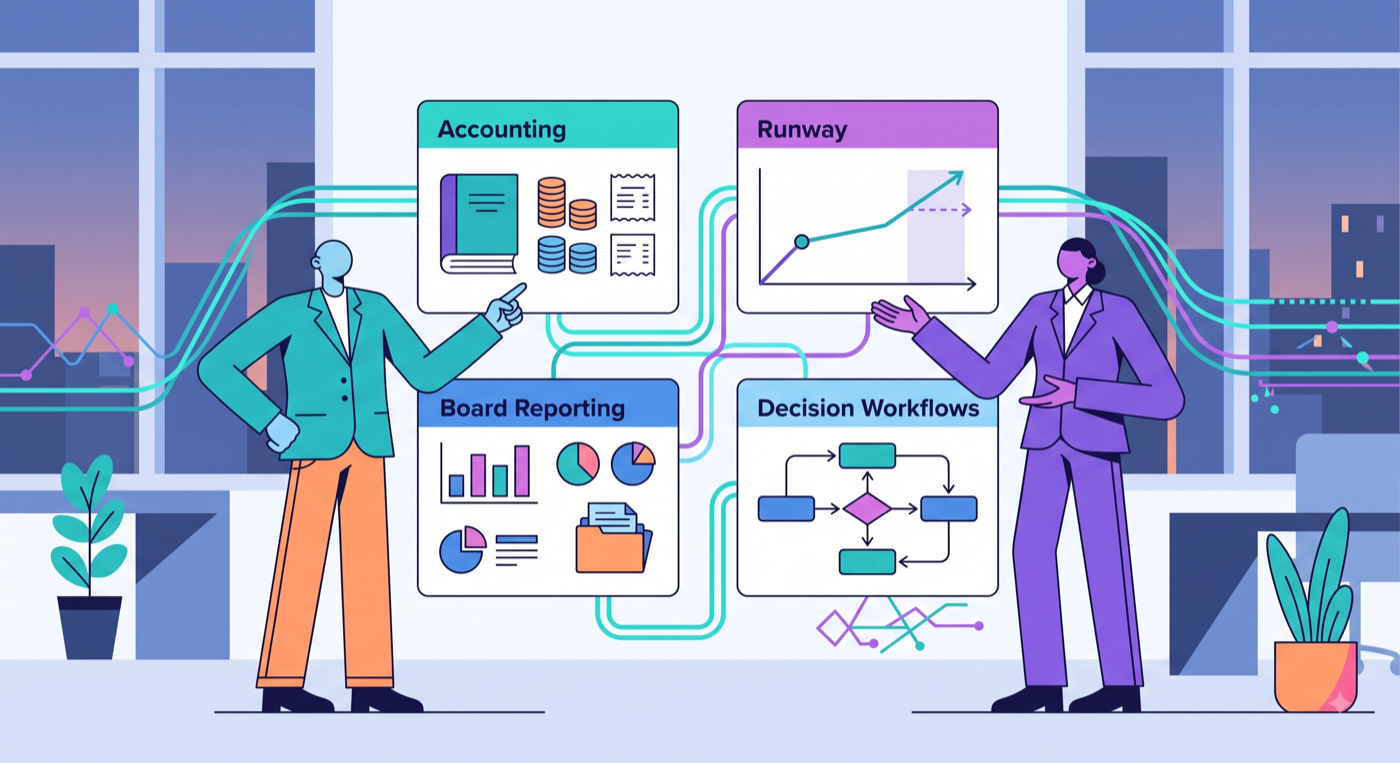
A true AI-native finance function solves the integration problem first. It ingests the live ledger, the MCA filings, and the operating metrics into a single, unified data schema. When a new hire is added to the payroll, the runway model and the ESOP pool should update simultaneously.
Why Generative AI is Not Enough
Generative AI is remarkably good at summarizing text and writing code, but it struggles with deterministic financial logic. You cannot prompt a generic large language model to calculate the dilution impact of a complex convertible note and expect an audit-proof answer.
Financial advisory requires agentic workflows—systems where AI models are constrained by strict financial formulas, regulatory frameworks, and deterministic calculators. The AI must be used to extract, structure, and route data, not to guess at math.
More importantly, high-stakes financial deliverables still require human accountability. A board of directors will not accept an AI-generated Management Information System (MIS) report that hasn’t been verified by a qualified operator.
The Octane Architecture
At Octane Advisors, we recognized early that the value of AI in finance is architectural, not conversational.
We do not sell a software tool for founders to play with. We use proprietary agentic systems to ingest your company’s data and build a live, unified model. Our AI handles the heavy lifting of data structuring, variance analysis, and initial report drafting.
This infrastructure allows our senior operators to bypass the administrative work and focus entirely on high-leverage judgment: pricing your equity, optimizing your unit economics, and signing off on your board packs. The technology does the math; we provide the signature.
Sign up for newsletter
Get practical finance and fundraising notes for fintech, D2C, and deep-tech founders.